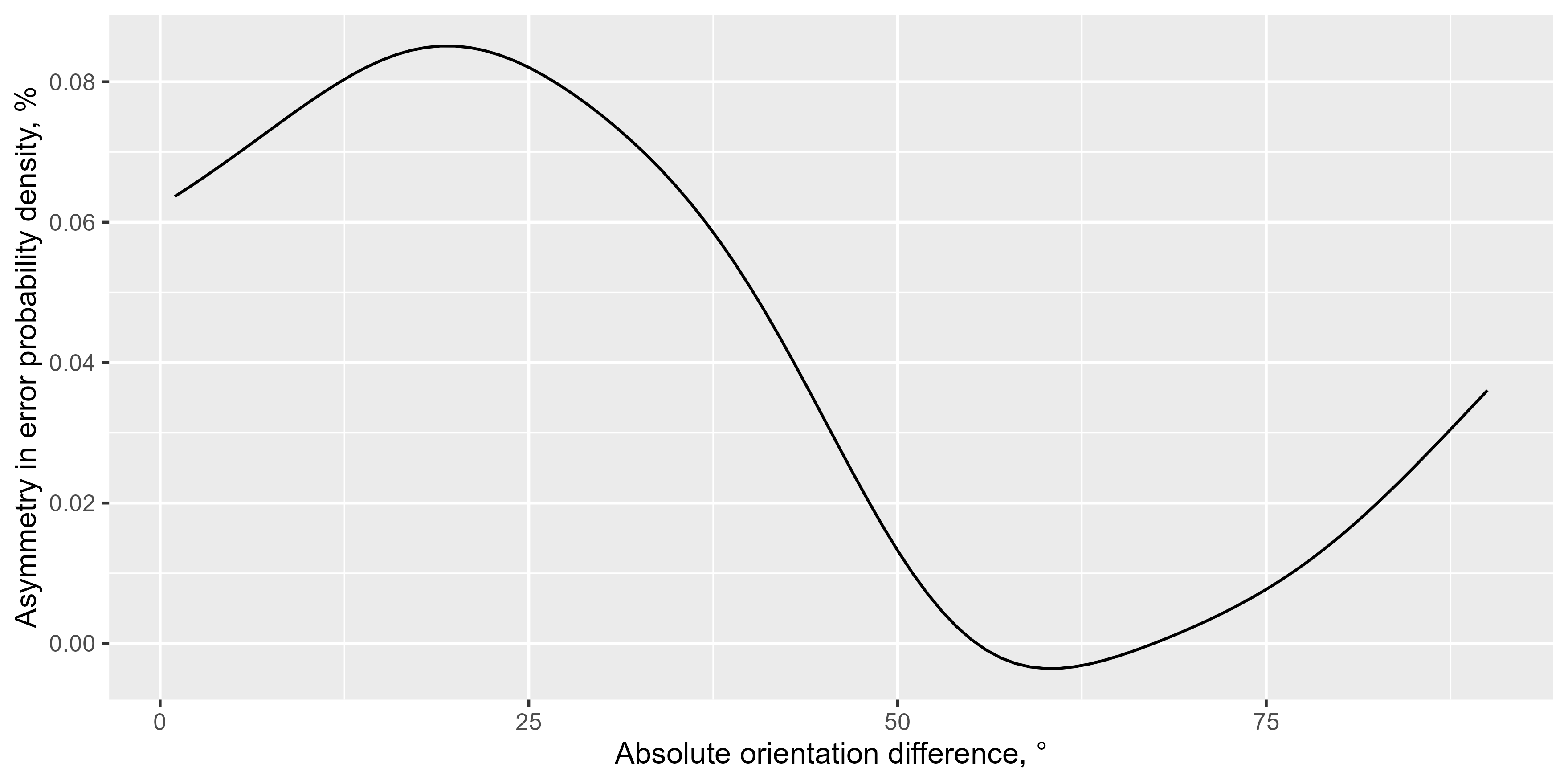
This function calculates the asymmetry in the probability density of a given variable (usually errors) relative to another variable (usually dissimilarity) using kernel density estimation. The asymmetry is computed for each x-axis value, and the result can be averaged or returned for each value individually.
Usage
density_asymmetry(
  dt,
  circ_space = 180,
  weights_sd = 10,
  kernel_bw = NULL,
  xvar = "abs_td_dist",
  yvar = "bias_to_distr_corr",
  by = c(),
  n = 181,
  average = T,
  return_full_density = F,
  normalize = T,
  wrap = TRUE,
  exclude_antipode = TRUE,
  n_wraps = 1,
  rescale_narrow = TRUE,
  scale_safety = 0.5
)
Arguments
- dt
data.table with the data.
- circ_space
Circular space, which can be 180 or 360 (default: 180).
- weights_sd
Standard deviation of the Gaussian window to use across
xvar(default: 10).- kernel_bw
Bandwidth for the kernel density estimator across
yvar. If NULL, it is computed usingstats::bw.SJ(). If "average", it is computed usingstats::bw.SJ()for each group indicated bybyand then averaged. Otherwise it is passed tostats::density()(default: NULL).- xvar
X-axis variable, such as dissimilarity between items (default: "abs_td_dist").
- yvar
Y-axis variable, normally errors (default: "bias_to_distr_corr").
- by
A vector of grouping variable names (default: an empty vector).
- n
The number of steps for the x-axis variable at which the density is computed (default: 181).
- average
If TRUE, the asymmetry is averaged for each x-value (default: TRUE).
- return_full_density
If TRUE, returns the full data.table with density computed at each point (default: FALSE).
- normalize
if TRUE, normalizes the difference in probability density by the total sum of probability density (with zero point excluded). Delta then corresponds to the probability of observing a given sign. In use only when average is TRUE.
- wrap
If TRUE (default), the kernel density estimate is wrapped around the circle, so that a kernel centred near one end of the
yvaraxis reappears at the other end instead of being truncated. Set to FALSE for the pre-1.4.0 (truncated) behaviour. On orientation or colour data, where errors sit near zero and the bandwidth is a few degrees, this changes nothing to ~1e-13; it matters whenyvarcarries mass near +/-circ_space/2, such as the 180-degrees-off reversals in motion-direction data.- exclude_antipode
If TRUE (default), the +/-
circ_space/2 point is dropped from the positive and negative sums, exactly like zero. It is the same angle approached from two sides and so has no sign, and withnodd it is otherwise counted twice (once as-max_dissand once as+max_diss). Set to FALSE for the pre-1.4.0 behaviour.- n_wraps
Number of periodic images summed on each side when
wrapis TRUE (default: 1). One is already far past double precision for any bandwidth much smaller thancirc_space.- rescale_narrow
If TRUE (default), a bandwidth narrower than the spacing of the
x_gridtriggers a rescaling ofyvarand the bandwidth by a common factor, so that the kernel is at least one grid cell wide. The asymmetry is a signed mass difference and a positive scaling preserves each value's sign, so the estimand is unchanged; this is equivalent to evaluating on a finer grid, but cheaper. Without it, a kernel narrower than a cell falls between grid points and the rectangle sum stops representing the density (atkernel_bw= dx/20 a point centred on a cell contributes 7.98x its mass and one half a cell away contributes 0).stats::bw.SJ()does reach that regime on real data. Set to FALSE for the pre-1.4.0 behaviour.- scale_safety
Fraction of
circ_space/2 that the rescaledyvarvalues are allowed to reach (default: 0.5). Rescaling treats the circular axis as linear, which is only valid while no mass is near the wrap, so the factor is capped rather than assumed safe.
Value
A data.table with the grouping variables, dist - the values of X-axis variable at which the density is computed, and delta - the difference (asymmetry) in probability density for positive and negative values of yvar; or the full density data if return_full_density is TRUE.
Examples
data(Pascucci_et_al_2019_data)
ex_data <- Pascucci_et_al_2019_data
ex_data[, err := angle_diff_180(reported, orientation)] # response errors
#>       observer orientation reported        rt   err
#>          <int>       <int>    <int>     <num> <num>
#>    1:        1         135      137 1.0829786     2
#>    2:        1          65       56 0.9887931    -9
#>    3:        1          61       65 1.5067748     4
#>    4:        1          27       25 1.9070205    -2
#>    5:        1          22       20 2.0247443    -2
#>   ---
#> 4396:       10          35       26 1.7775651    -9
#> 4397:       10         141      135 2.0365374    -6
#> 4398:       10         178      163 1.1301296   -15
#> 4399:       10         168      168 1.3772832     0
#> 4400:       10          24       28 2.3897599     4
ex_data[, prev_ori := shift(orientation), by = observer] # orientation on previous trial
#>       observer orientation reported        rt   err prev_ori
#>          <int>       <int>    <int>     <num> <num>    <int>
#>    1:        1         135      137 1.0829786     2       NA
#>    2:        1          65       56 0.9887931    -9      135
#>    3:        1          61       65 1.5067748     4       65
#>    4:        1          27       25 1.9070205    -2       61
#>    5:        1          22       20 2.0247443    -2       27
#>   ---
#> 4396:       10          35       26 1.7775651    -9       68
#> 4397:       10         141      135 2.0365374    -6       35
#> 4398:       10         178      163 1.1301296   -15      141
#> 4399:       10         168      168 1.3772832     0      178
#> 4400:       10          24       28 2.3897599     4      168

# determine the shift in orientations between trials
ex_data[, diff_in_ori := angle_diff_180(prev_ori, orientation)]
#>       observer orientation reported        rt   err prev_ori diff_in_ori
#>          <int>       <int>    <int>     <num> <num>    <int>       <num>
#>    1:        1         135      137 1.0829786     2       NA          NA
#>    2:        1          65       56 0.9887931    -9      135          70
#>    3:        1          61       65 1.5067748     4       65           4
#>    4:        1          27       25 1.9070205    -2       61          34
#>    5:        1          22       20 2.0247443    -2       27           5
#>   ---
#> 4396:       10          35       26 1.7775651    -9       68          33
#> 4397:       10         141      135 2.0365374    -6       35          74
#> 4398:       10         178      163 1.1301296   -15      141         -37
#> 4399:       10         168      168 1.3772832     0      178          10
#> 4400:       10          24       28 2.3897599     4      168         -36
ex_data[, abs_diff_in_ori := abs(diff_in_ori)]
#>       observer orientation reported        rt   err prev_ori diff_in_ori
#>          <int>       <int>    <int>     <num> <num>    <int>       <num>
#>    1:        1         135      137 1.0829786     2       NA          NA
#>    2:        1          65       56 0.9887931    -9      135          70
#>    3:        1          61       65 1.5067748     4       65           4
#>    4:        1          27       25 1.9070205    -2       61          34
#>    5:        1          22       20 2.0247443    -2       27           5
#>   ---
#> 4396:       10          35       26 1.7775651    -9       68          33
#> 4397:       10         141      135 2.0365374    -6       35          74
#> 4398:       10         178      163 1.1301296   -15      141         -37
#> 4399:       10         168      168 1.3772832     0      178          10
#> 4400:       10          24       28 2.3897599     4      168         -36
#>       abs_diff_in_ori
#>                 <num>
#>    1:              NA
#>    2:              70
#>    3:               4
#>    4:              34
#>    5:               5
#>   ---
#> 4396:              33
#> 4397:              74
#> 4398:              37
#> 4399:              10
#> 4400:              36
ex_data[, err_rel_to_prev_targ := ifelse(diff_in_ori < 0, -err, err)]
#>       observer orientation reported        rt   err prev_ori diff_in_ori
#>          <int>       <int>    <int>     <num> <num>    <int>       <num>
#>    1:        1         135      137 1.0829786     2       NA          NA
#>    2:        1          65       56 0.9887931    -9      135          70
#>    3:        1          61       65 1.5067748     4       65           4
#>    4:        1          27       25 1.9070205    -2       61          34
#>    5:        1          22       20 2.0247443    -2       27           5
#>   ---
#> 4396:       10          35       26 1.7775651    -9       68          33
#> 4397:       10         141      135 2.0365374    -6       35          74
#> 4398:       10         178      163 1.1301296   -15      141         -37
#> 4399:       10         168      168 1.3772832     0      178          10
#> 4400:       10          24       28 2.3897599     4      168         -36
#>       abs_diff_in_ori err_rel_to_prev_targ
#>                 <num>                <num>
#>    1:              NA                   NA
#>    2:              70                   -9
#>    3:               4                    4
#>    4:              34                   -2
#>    5:               5                   -2
#>   ---
#> 4396:              33                   -9
#> 4397:              74                   -6
#> 4398:              37                   15
#> 4399:              10                    0
#> 4400:              36                   -4

err_dens <- density_asymmetry(ex_data[!is.na(err_rel_to_prev_targ)],
  circ_space = 180, weights_sd = 10, xvar = "abs_diff_in_ori",
  yvar = "err_rel_to_prev_targ", by = c("observer")
)

library(ggplot2)
ggplot(err_dens, aes(x = dist, y = delta)) +
  geom_line(stat = "summary", fun = mean) +
  labs(y = "Asymmetry in error probability density, %", x = "Absolute orientation difference, °")